
For club and high school coaches
You see the moments that get a player recruited.
You are in the cage on a Tuesday and on the line at seven in the morning. Nobody else has that footage. Film it, and every player on your roster leaves the season with a reel to send to colleges — and you become the reason a college saw them.
Film once, send every family their own child
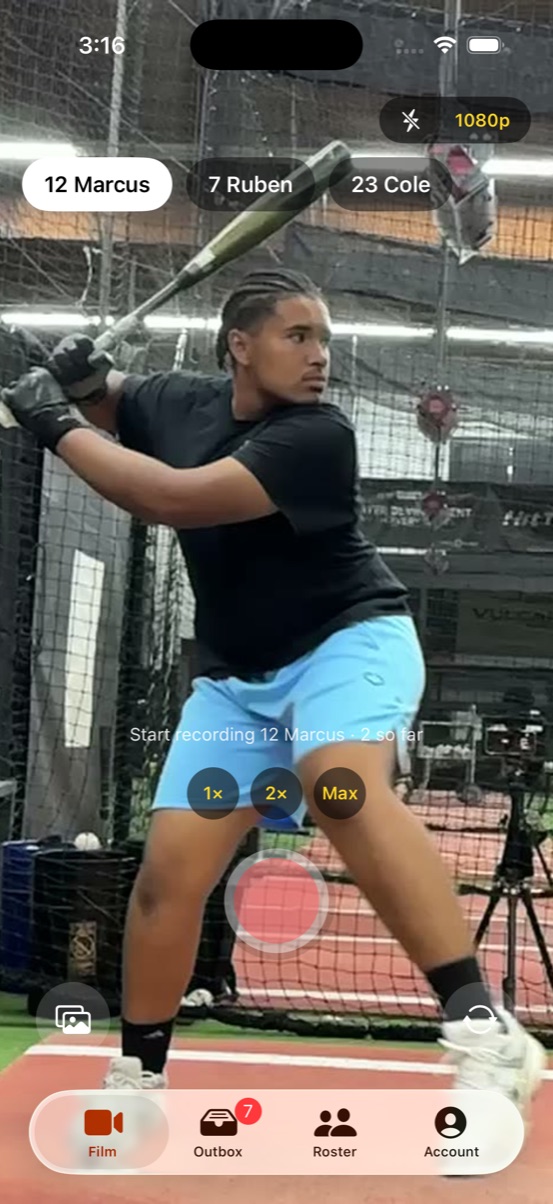
Open the app in the dugout, tap a name, and film. Tag each clip as you go, press send once, and every parent gets an email with their own child’s clips — not the whole team’s, and not a folder to scroll.
Film today’s practice, send it tonight, and your phone is clear again. The clips live in the app, not your camera roll, and they leave your phone once they are sent — nothing to sort, nothing filling your storage.
01
Add your roster
First and last name is enough. Parents' addresses can come later, or from the families themselves.
02
Tap a name, then film
The camera stays on the player you picked. Zoom, switch lenses, keep or bin each take.
03
Send once
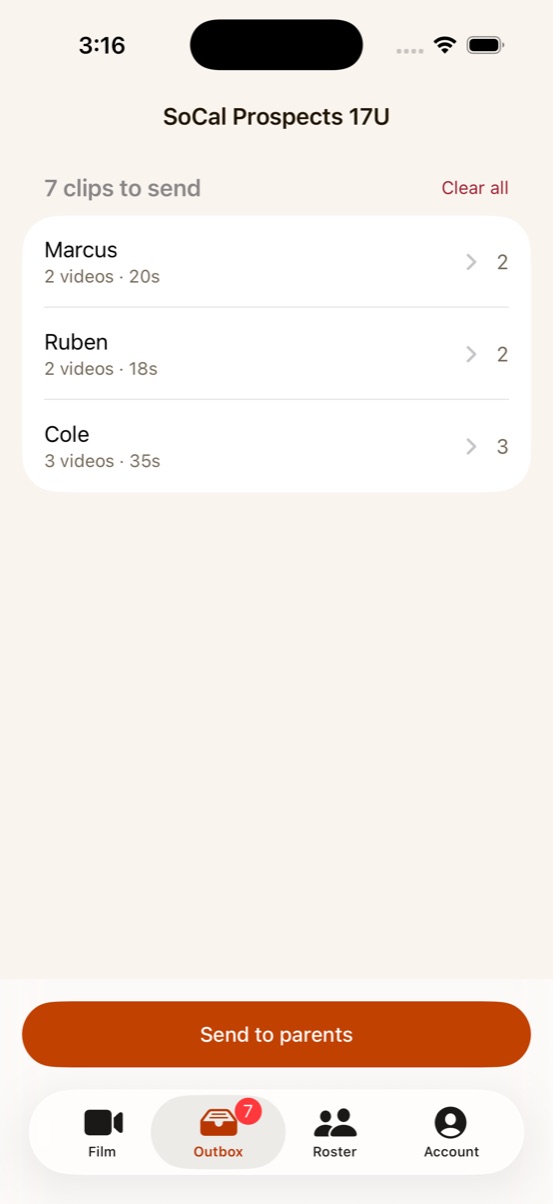
Everything you filmed goes out in one press — each family gets only their own child's clips, and the clips leave your phone.
04
They claim a page
The email carries a link to a scout page already holding their clips. What they do with it is theirs.
Say the thing the stats do not
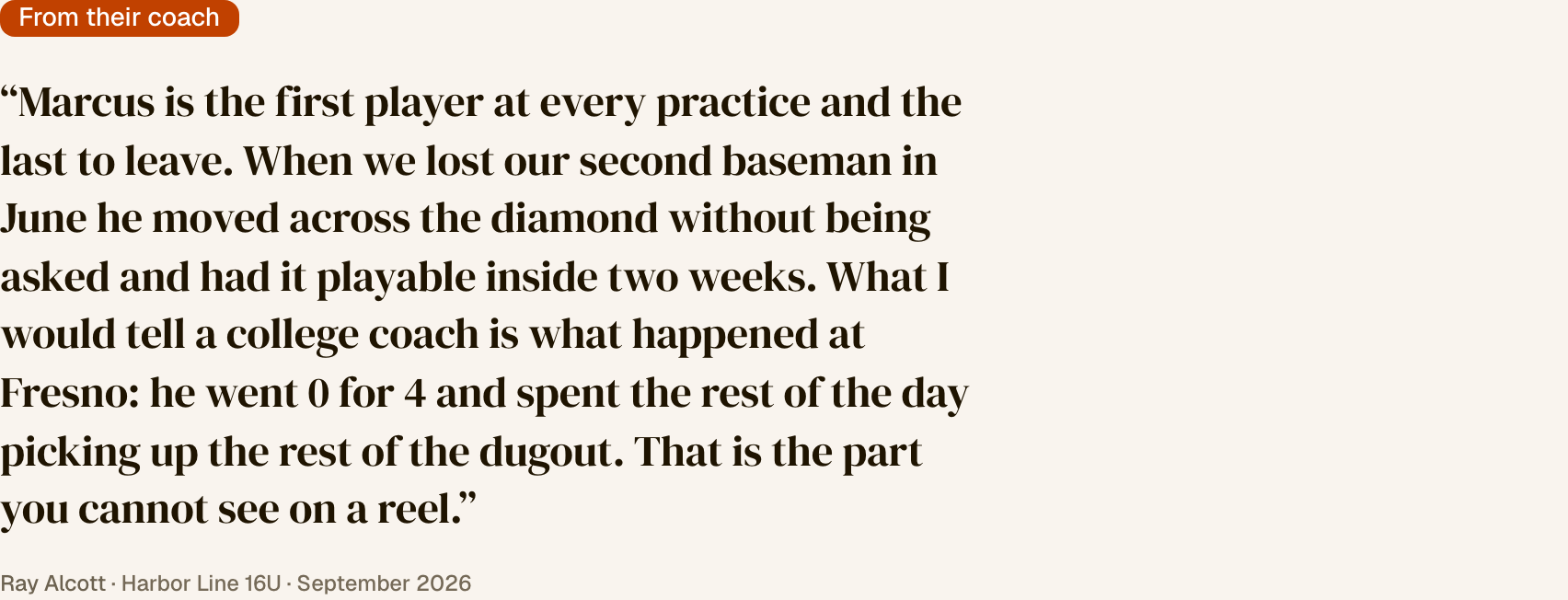
A college coach reading a scout page can see the numbers and the video. What they cannot see is whether the player is first to practice, whether they moved to a new position without being asked, or how they were in the dugout after going 0 for 4. You know all three.
Talk for forty seconds. We write it up. You approve every word before it goes anywhere — and it appears on the page under your name, as your judgement, because that is the only reason it carries any weight.
It is a few sentences, not a reference letter, and you can change or remove it whenever you like.
Write to a college about your whole infield at once
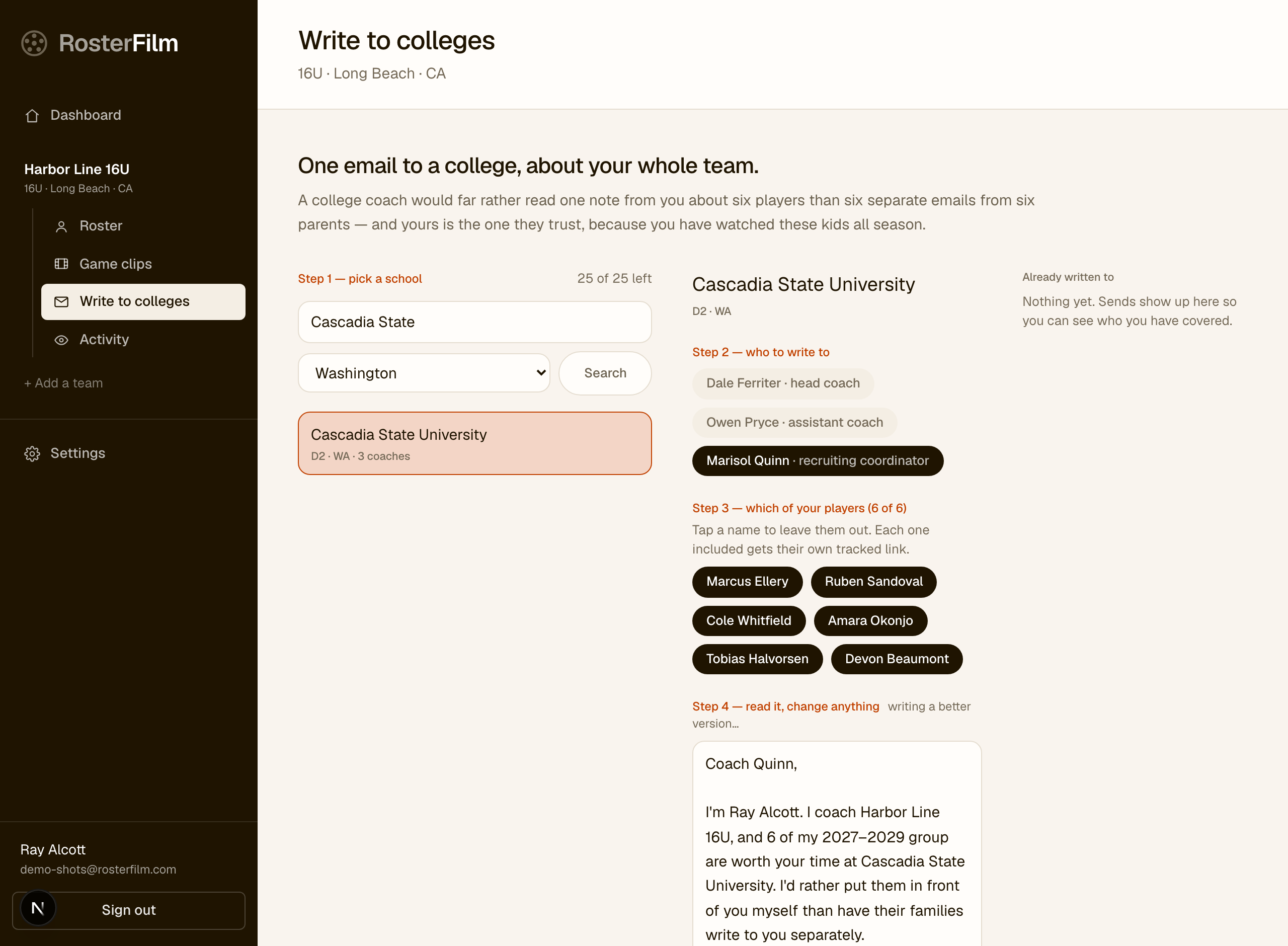
Six families writing separately to the same recruiting coordinator is six cold emails. One email from you about six players is a scouting tip — and it is the same list of programs, the same addresses, read from each school’s own staff page.
Pick the players, pick the programs, and send. Each player’s own page and clips travel with them in it, so a coach who is interested in one of the six does not have to write back and ask.
This is the opening send, once or twice a season — not a mail campaign. Chasing the programs that showed interest stays with each family.
Who’s watching
Then you find out it worked.
Every link that goes out is unique to one program. Nobody has to sign in, install anything, or agree to be tracked for this to work — the link itself is the identifier. When a college opens a player’s reel and watches it through, that is a fact, and it gets back to the people it matters to.

- Each family decides
- A parent switches this on for their own child. Until they do, you see nothing about that player — and you will be told that is why, rather than shown an empty row.
- You see that it happened
- For a family on the free plan: a college opened your player's reel and watched it to the end. That is the fact that justifies filming another season.
- They see which college
- Naming the school is what a family's own subscription buys — the college list is the paid product, and it is sold to them, not to you. If they are on it, you see the name too.
You are filming other people’s children. We know.
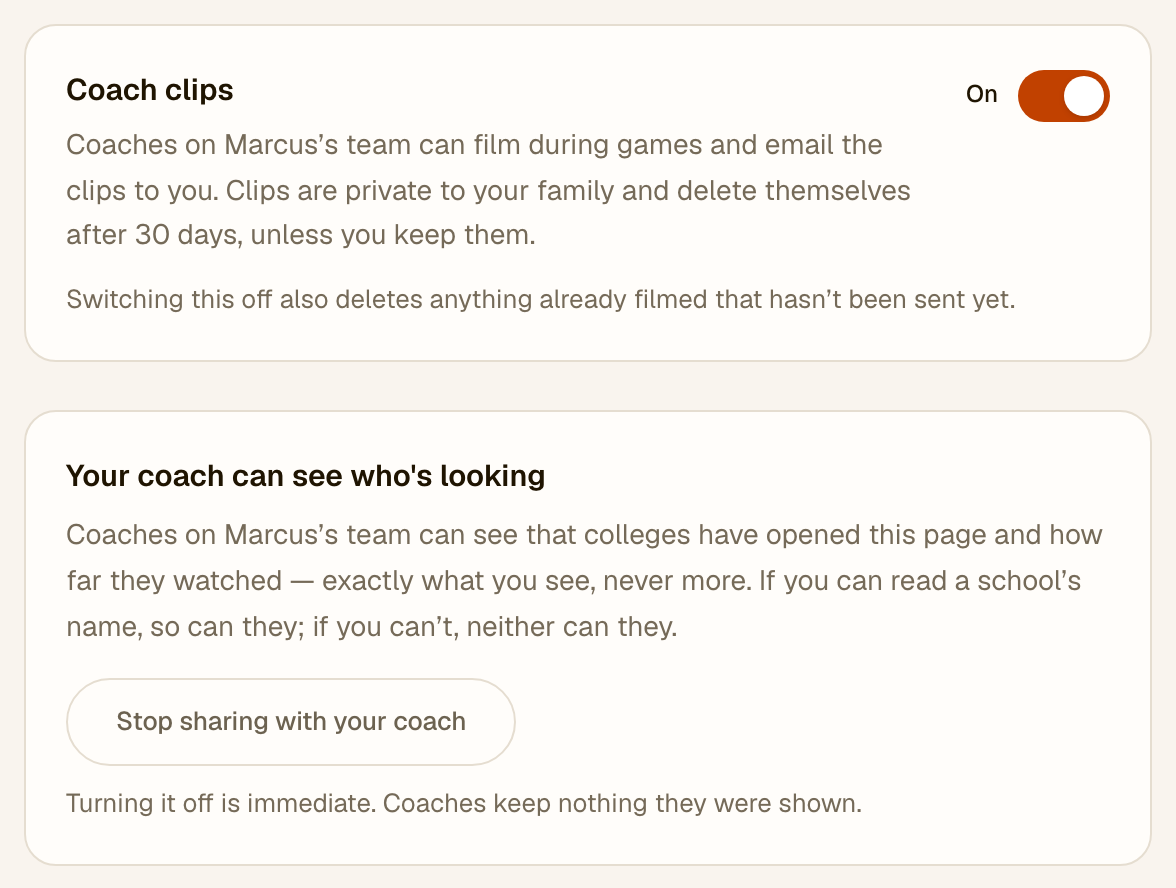
So the answer is not a policy page you agree to without reading. It is three things the product actually does, and you can check every one of them.
- You confirm permission first
- Before the first clip leaves your phone, you confirm you have the families' permission. Nothing sends until you do.
- Each parent can switch it off
- For their own child, at any time, without asking you and without affecting anybody else on the roster.
- Every clip deletes itself
- Thirty days, and then it is gone — unless that family has chosen to keep it in their own account, where it belongs to them and not to us.
Nothing, and here is why that is not a trick.
The thing we sell is the college coach list, and we sell it to families — the ones who want to know which programs opened their player’s reel and who to write to next. You filming your team is how those families find us in the first place.
So there is no coach tier, no per-player charge, and no seat you run out of. Film the roster, send the clips, put your name on a page. None of it costs you anything, this season or the next one.
The season is going to happen either way.
Somebody on your team will have a moment this season that nobody films. Two minutes on the sideline is the difference between that and a page a college coach opens.
The camera is in the app · Get the iPhone app · Get the Android app